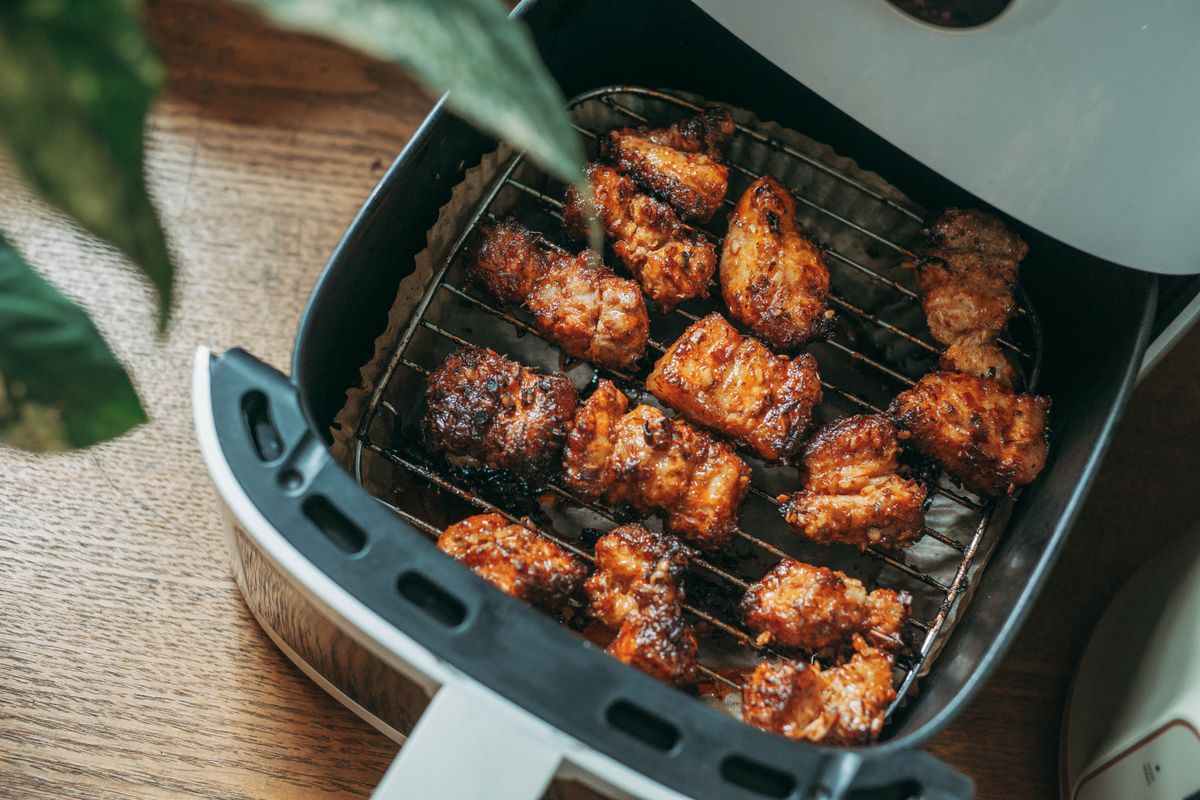
I Ruined Three Dinners Before I Learned How to Actually Convert Oven Recipes for an Air Fryer
The first time I air-fried frozen fries, I set the basket to 425°F for 20 minutes because that's what the bag said for a regular oven. Ten minutes in, the kitchen smelled like a diner fryer that needed cleaning. What came out was blackened and brittle on the outside, still faintly cold in the middle of the thicker fries. Two nights later I did almost the same thing to a tray of chicken thighs — technically "done" by the timer, but the skin had gone past crispy into bitter before the inside caught up. Both times the recipe wasn't wrong. I was just running an oven recipe on a machine that isn't an oven, at least not in the way that matters for timing.
An air fryer is a small convection oven with the fan and heating element crammed much closer to the food, so heat transfers faster and the surface browns harder at the same dial setting. Using an oven's printed temperature and time as-is almost always overshoots. Once I started applying an actual conversion — not a guess, a specific number pulled from a formula — every batch since has come out matching what the original recipe photo looked like.
Why Do Air Fryers Cook Faster Than a Regular Oven?
An air fryer is a compact convection appliance that circulates hot air within inches of the food, rather than across the several cubic feet of space inside a full-size oven. That shorter distance and more concentrated airflow transfer heat to the food's surface much faster, which is why the same dial setting browns and crisps food more aggressively — and finishes it sooner — in an air fryer than in an oven.
According to Instant Brands and multiple other air fryer manufacturers, food cooked in a basket-style air fryer typically finishes 20–25% faster than the same food in a conventional oven set to the recipe's printed temperature. That's the gap that caught me out with the fries: I used the oven's time, on a machine that was already going to finish in four-fifths of it, and the extra minutes had nowhere to go but into scorched starch.

Key Takeaway
An oven recipe's temperature and time are calibrated for a large, relatively slow-heating cavity. Feed those same numbers into an air fryer without adjusting, and you're guaranteed to overcook the outside before the inside catches up — the exact opposite of what most people expect from a "faster" appliance.
What's the Rule of Thumb for Oven-to-Air-Fryer Conversion?
The standard oven-to-air-fryer conversion rule, used across cooking publications and appliance manufacturers, is to lower the temperature by about 25°F (roughly 14°C) and cut the cooking time by about 20% for a basket-style air fryer. The temperature drop compensates for how much more efficiently the smaller cavity transfers heat, and the time cut accounts for how much faster that heat actually cooks the food through.
Air Fryer Time = Oven Time × 0.80
That's the formula for a standard basket-style unit — the most common design (Ninja, Philips, Cosori, and similar). It's not the only version, though: air fryer ovens with bigger cavities, like the Instant Omni or Cuisinart TOA, and toaster-oven air-fry settings both need a smaller adjustment because their airflow is less concentrated than a compact basket. More on that distinction further down.
💡 Pro Tip
Round the converted temperature to the nearest 5 or 25 degrees rather than obsessing over the exact decimal — most air fryer dials only step in 5° or 10° increments anyway, and the reduction is already an approximation of how your specific unit behaves.
Rather than doing this math by hand every time a recipe calls for the oven, the Air Fryer Conversion Calculator runs exactly this formula — enter the oven temperature, time, and your air fryer style, and it returns the adjusted numbers instantly, in either Fahrenheit or Celsius.
Two Worked Examples: Fries and Chicken Breast
Here's the math from my two kitchen disasters, done properly this time.
Frozen fries, printed oven instructions: 400°F for 25 minutes, basket-style air fryer.
25 min × 0.80 = 20 min
Chicken breast, printed oven instructions: 375°F for 30 minutes, basket-style air fryer.
30 min × 0.80 = 24 min
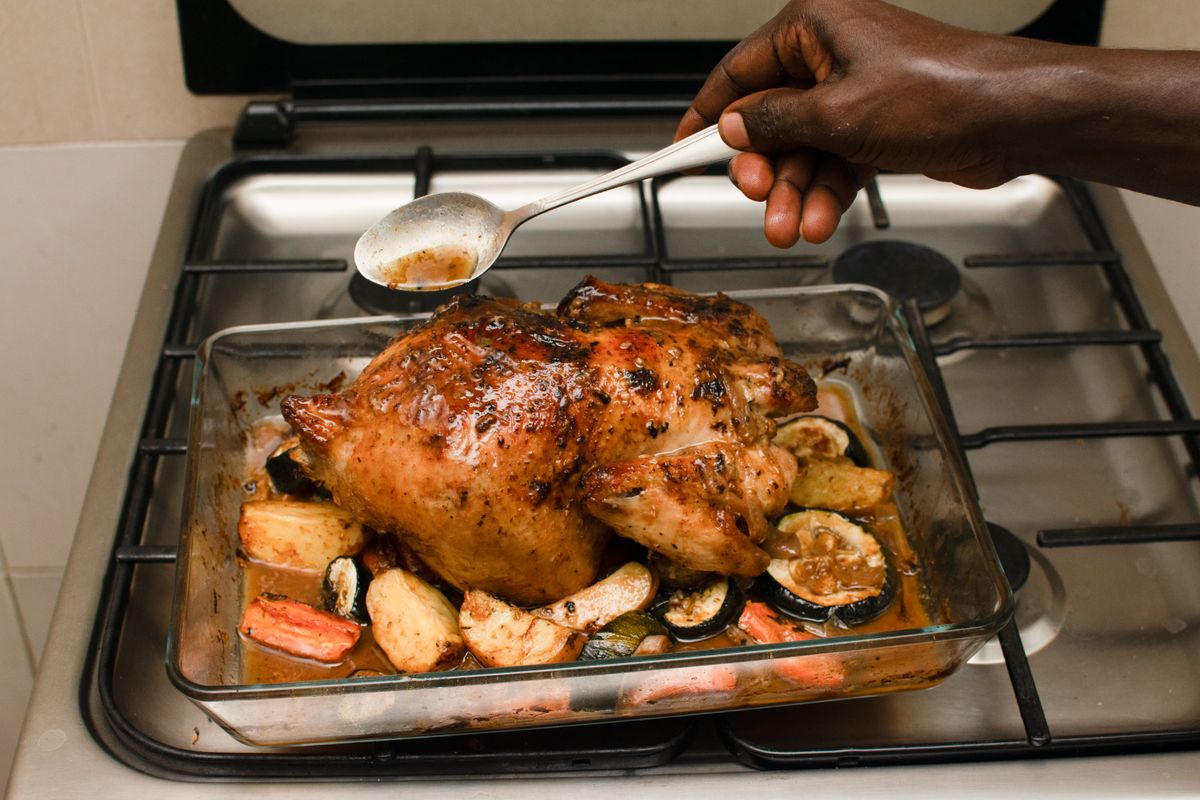
For a UK or Australian reader working in Celsius, the same logic applies with a smaller absolute number: a Sunday roast chicken at 200°C for 90 minutes in an air fryer oven (which uses a smaller 10°C reduction and a 15% time cut, per the style-specific table below) converts to roughly 190°C for about 77 minutes.
⚠️ Note
Treat every converted number as a starting point, not a guarantee. Air fryer wattage, basket size, and how much food is crammed in at once all shift the real cook time. Start checking a few minutes before the calculated time, and confirm meat and poultry with an instant-read thermometer rather than trusting the clock alone.
Air Fryer Conversion Chart for Common Foods
Here's the same basket-style formula (−25°F / −20% time) applied to the foods people convert most often, so you've got a reference without doing the arithmetic mid-recipe.
| Food | Oven Setting | Air Fryer (Basket) |
|---|---|---|
| Frozen french fries | 425°F / 20 min | 400°F / 16 min |
| Chicken wings | 400°F / 45 min | 375°F / 36 min |
| Chicken breast | 375°F / 30 min | 350°F / 24 min |
| Salmon fillet | 400°F / 15 min | 375°F / 12 min |
| Roasted vegetables | 425°F / 25 min | 400°F / 20 min |
| Frozen mozzarella sticks | 400°F / 12 min | 375°F / 10 min |
Key Takeaway
Thin, already-crispy-coated foods (fries, mozzarella sticks, chicken wings) tend to convert the most predictably, because they're mostly surface area — exactly what the higher, more concentrated air fryer airflow is best at. Thicker cuts of meat benefit most from double-checking doneness with a thermometer rather than trusting the converted time alone.
Does the Type of Air Fryer Change the Conversion?
Yes — "air fryer" now covers three meaningfully different designs, and using the basket-style −25°F rule on a larger unit will under-convert it.
| Air Fryer Style | Temp Reduction | Time Reduction |
|---|---|---|
| Basket-style (Ninja, Philips, Cosori) | −25°F (−15°C) | −20% |
| Air fryer oven (Instant Omni, Cuisinart) | −20°F (−10°C) | −15% |
| Toaster oven air-fry setting | −15°F (−10°C) | −10% |
Basket-style units pack a powerful fan into a small, enclosed drawer just inches from the food, which is why they get the largest reduction. Air fryer ovens — larger countertop units with a door instead of a pull-out basket — have more internal volume, so airflow is less concentrated and the adjustment is smaller. Toaster ovens with an air-fry setting have the biggest cavity of the three and the mildest fan, so they need the smallest reduction of all, closest to a true oven's behavior.

Getting the style wrong is a common source of "the calculator's numbers didn't work for me" complaints — someone runs the basket-style −25°F reduction on a large air fryer oven and ends up under-cooking, or applies the mild toaster-oven adjustment to a compact basket unit and ends up back where I started with the fries. The Air Fryer Conversion Calculator has all three styles built in, so you're applying the right reduction for your actual appliance rather than a generic one.
Frequently Asked Questions
What is the standard rule for converting oven temperature to an air fryer?
For a basket-style air fryer, reduce the oven temperature by 25°F (about 14–15°C) and cut the cooking time by roughly 20%. A recipe calling for 400°F for 25 minutes in the oven becomes about 375°F for 20 minutes in a basket air fryer.
Why does food burn on the outside but stay undercooked inside in an air fryer?
This happens when the oven's original temperature is used unchanged. The air fryer's concentrated airflow browns the surface much faster than an oven would at that same setting, so by the time the center reaches a safe temperature, the outside has already overcooked. Lowering the temperature by the standard 20–25°F gives the inside time to catch up before the surface burns.
Do I need to preheat an air fryer before cooking?
Most air fryers benefit from 2–3 minutes of preheating, similar to a conventional oven. Skipping it can quietly add several minutes to the actual cook time and throw off the converted estimate, so preheat whenever your model supports it and treat that time as separate from the cook time in the chart above.
Does food need to be flipped or shaken differently in an air fryer than in an oven?
Generally yes. Because air fryers cook via fast, directional airflow rather than the more even ambient heat of an oven, shaking the basket or flipping food halfway through — something many oven recipes don't call for at all — makes a bigger difference to even browning in an air fryer.
Is the 25°F / 20% conversion exact for every air fryer model?
No — it's an industry-standard starting point, not a guarantee. Actual results vary by wattage, basket size, and how much food is loaded at once. Always check a few minutes before the converted time and confirm meat and poultry with a food thermometer.
Try It Yourself
The gap between an oven's numbers and an air fryer's numbers is small on paper — 25 degrees, a fifth of the time — but it's exactly the gap that turned my frozen fries into charcoal. Run your own recipe through the Air Fryer Conversion Calculator, pick your air fryer style, and get the adjusted temperature and time in Fahrenheit or Celsius instantly.
Also worth checking:
- Recipe Scaling Calculator — for adjusting ingredient quantities when you're doubling or halving a recipe
- Cooking Time Calculator — for adjusting roast timings by weight
- Recipe Converter — for switching between US and metric measurements