My Vet Scored My Dog a 7 Out of 9 — Turns Out the Bag's Feeding Chart Was the Problem
My Labrador, Bear, was 61 lbs at his annual checkup — up from 54 the year before — and the vet ran her hands along his ribs, felt around his waist, and gave him a body condition score of 7 out of 9. "Overweight, heading toward obese," she said. I'd been feeding him exactly what the bag recommended the whole time, faithfully bumping up his portion each time he crossed into a new weight bracket on the chart, because that's what the chart is for.
That was the actual problem. A weight-based feeding chart looks up your dog's portion by whatever they currently weigh — so as Bear got heavier, the chart itself told me to feed him more, reinforcing the exact trend that got him there. It has no way of knowing his ideal weight is closer to 55 lbs, or that a 7-out-of-9 dog needs to be fed toward a target weight, not a current one. Vets use a formula that can account for that. Once I ran Bear's numbers through it, the difference between "feeding the bracket he's in" and "feeding the dog he should be" was stark.
⚠️ Disclaimer
This article is for general informational purposes only and does not replace advice from your veterinarian. Always confirm portion sizes and any diet changes with a vet, especially for puppies, senior dogs, or dogs with existing health conditions.
Why the Feeding Chart on the Bag Gets It Wrong
A dog food bag's feeding chart is a generic average, not a calculation for your specific dog. It's usually built around an intact, moderately active adult dog at a given weight — it doesn't know if your dog is spayed or neutered (which lowers metabolic needs by roughly 20–30%), how active they really are day to day, or whether they're already overweight and need fewer calories to get back to a healthy range, not more.
That mismatch adds up fast. The Association for Pet Obesity Prevention has found that more than half of dogs in the United States are classified as overweight or obese in every survey it has run over the past decade — and one of the most common root causes owners report, once a vet walks them through it, is simply feeding to the bag's chart instead of the dog in front of them.

Key Takeaway
Two dogs can weigh exactly the same and need meaningfully different calorie totals, depending on whether they're neutered, how active they are, and their current body condition. A weight-only feeding chart can't capture any of that.
How Do Vets Actually Calculate Dog Food Portions?
Veterinary nutritionists start from Resting Energy Requirement (RER) — the calories a dog burns at complete rest just to keep its organs and basic body functions running. RER scales with body weight raised to the power of 0.75 rather than in a straight line, because larger animals are metabolically more efficient per pound than smaller ones — the same reason a Great Dane doesn't need proportionally as many calories per pound as a Chihuahua.
RER on its own only covers a dog lying still all day. To get an actual daily calorie target, RER gets multiplied by a life-stage factor (how a dog's age and reproductive status change its baseline metabolism) and an activity factor (how much extra energy their actual day-to-day movement burns):
| Life stage | Factor |
|---|---|
| Puppy, under 4 months | 3.0 |
| Puppy, 4–12 months | 2.0 |
| Intact adult | 1.8 |
| Neutered/spayed adult | 1.6 |
| Weight loss | 1.0 |
| Senior (7+ years) | 1.4 |
| Activity level | Factor |
|---|---|
| Sedentary | 1.0 |
| Moderate | 1.2 |
| Active | 1.4 |
| Working dog | 1.6 |
Bear's Numbers, Worked Out
Bear is a neutered adult Labrador at 61 lbs (27.7 kg) with moderate activity — a couple of 30-minute walks a day, nothing more. Feeding at his current weight, the formula gives:
Applying his life-stage factor (1.6 for neutered adult) and activity factor (1.2 for moderate):
His kibble runs 350 kcal per cup, a typical density for dry dog food, which works out to about 4.6 cups a day (roughly 510 grams — a useful cross-check if your food's packaging lists grams instead of cups, standard in the UK, Australia, and most of Europe). That's the number a weight-based chart would converge on too, at 61 lbs: keep feeding a heavier dog like a heavier dog, and the chart just keeps agreeing with the scale.
The number that actually matters is different: what Bear needs to reach 55 lbs, not maintain 61.
💡 Pro Tip
Skip the manual exponent math entirely with the Dog Food Portion Calculator — enter weight in kg or lbs, pick a life stage and activity level, and it returns daily calories plus cups and grams per day, split across 2 or 3 meals.
Is Your Dog Actually a Healthy Weight? Check the Body Condition Score
The Body Condition Score (BCS) is a 9-point scale, developed and endorsed by the World Small Animal Veterinary Association (WSAVA), that assesses a pet's weight by feel and appearance rather than by the number on a scale alone. A number on its own can't tell you whether 61 lbs is lean or overweight for a specific dog — a big-boned Labrador and a small one can weigh the same and sit at opposite ends of the scale.
| Score | Category | What it feels like |
|---|---|---|
| 1–3 | Underweight | Ribs, spine, and hip bones visible with no fat cover |
| 4–5 | Ideal | Ribs easily felt with a slight fat cover; visible waist from above |
| 6–7 | Overweight | Ribs felt with difficulty; waist barely visible or absent |
| 8–9 | Obese | Ribs not felt under heavy fat; no waist; fat deposits on chest and base of tail |
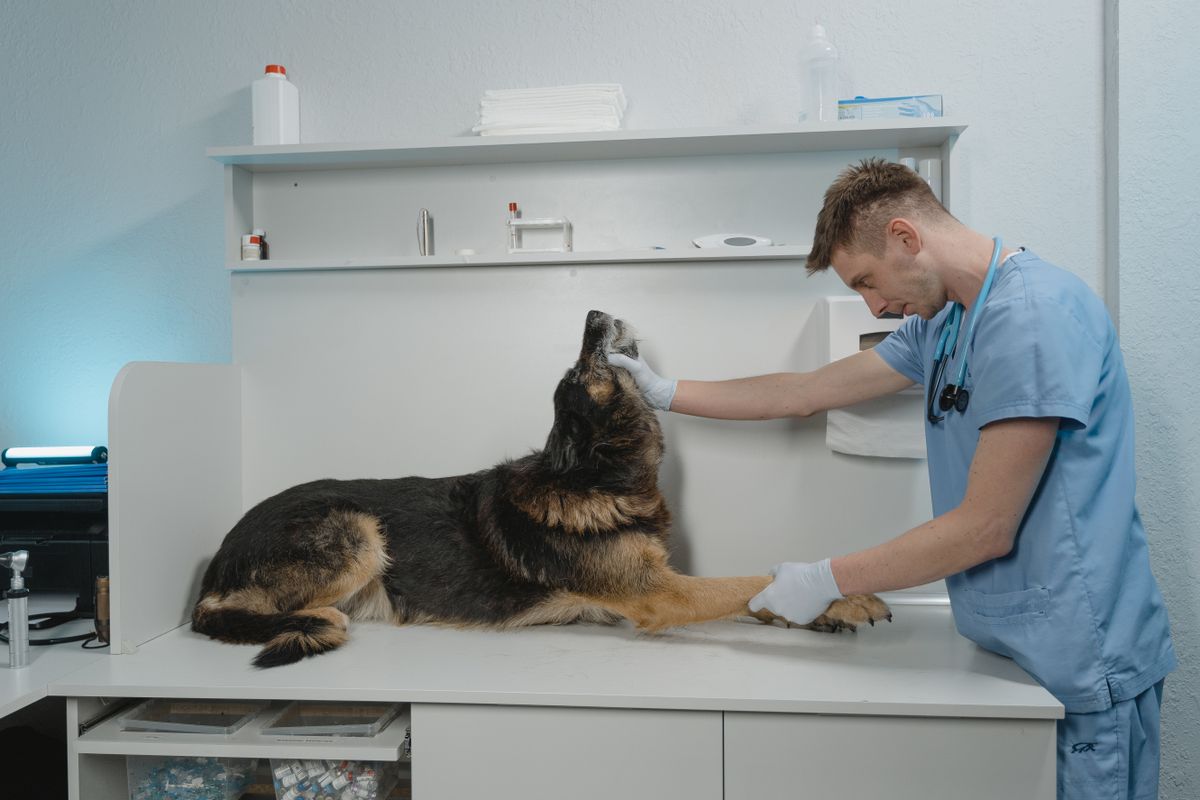
Bear scored a 7: his ribs were palpable but took real pressure to find, and from above there was no visible waist tuck behind his ribcage — just a straight line from ribs to hips.
⚠️ Note
A body condition score of 6–7 or higher is exactly when a "weight loss" life-stage factor (1.0 in the table above, instead of 1.6) makes sense — feeding toward a target weight rather than the current one, under veterinary guidance.
Turning Calories Into Cups and Grams
Every dry dog food lists its caloric density on the bag, usually in kcal per cup or kcal per kilogram — and this number varies more between brands than most owners expect. A calorie-dense performance formula can run over 450 kcal per cup, while a weight-management formula can sit closer to 300, meaning the same daily calorie target produces very different cup measurements depending on which bag you're scooping from.

That's why "3.5 cups" printed on one bag and "3.5 cups" printed on a different brand's bag can represent two genuinely different calorie totals — the cup measurement only means something once you know the specific food's kcal-per-cup value, which is exactly why a generic weight-to-cups chart is a rough approximation at best.
Puppies, Seniors, and Weight-Loss Plans
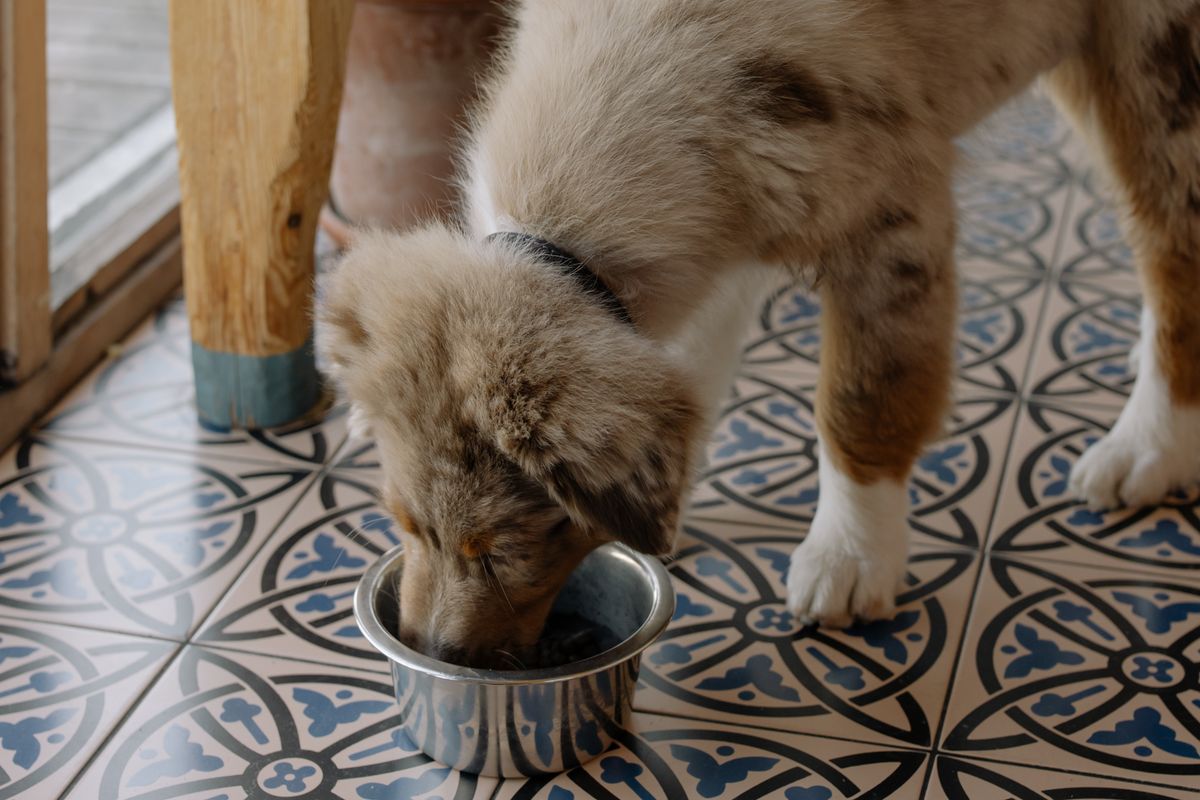
Life stage changes the multiplier dramatically, not just slightly. A puppy under 4 months old uses a life-stage factor of 3.0 — triple the baseline RER — because growth itself is metabolically expensive on top of normal maintenance. A puppy between 4 and 12 months drops to 2.0 as growth slows, and by adulthood, a neutered dog settles to around 1.6.
Senior dogs (generally 7 years and older, though this varies by breed size) typically use a lower factor around 1.4, reflecting a naturally slower metabolism and often reduced activity — feeding a senior dog like a young adult is a common way extra weight accumulates gradually over a few years without anyone noticing month to month.
For a dog already at a 6–7+ body condition score, most vets recommend calculating calories against the dog's target weight rather than current weight, using the lower weight-loss factor (1.0 instead of 1.6). Run against Bear's 55 lb (24.9 kg) target instead of his current 61:
That's roughly 2.7 cups a day — a meaningful cut from the 4.6 cups his current weight was pulling toward, not something to switch to overnight. Vets typically taper a reduction like this in over a week or two, with regular reweighing to track the trend rather than chasing a single number.
Frequently Asked Questions
Why did my vet's recommendation differ from the bag's feeding chart?
Bag charts are generic averages for a weight range, not calculations for your specific dog. A vet (or the RER formula above) factors in neuter status, activity level, and current body condition — all of which shift the number meaningfully in either direction.
How often should I re-weigh my dog and adjust portions?
Most vets suggest checking weight and body condition score every 2–4 weeks when actively adjusting a diet, and at minimum every 6 months for a stable adult dog. Small, gradual changes are easy to miss without a regular check-in.
Does wet food use the same formula as dry kibble?
The RER and daily calorie calculation is identical — calories are calories regardless of food form. What changes is the caloric density used to convert calories into a serving size, since wet food is typically far less calorie-dense per cup or can than dry kibble, due to its higher water content.
Should treats count toward the daily calorie total?
Yes. Most veterinary guidance suggests treats make up no more than 10% of a dog's total daily calories, with the rest coming from complete, balanced dog food. If treats aren't subtracted from the calculated daily total, they're effectively extra calories on top of an already-complete diet.
Is it safe to switch a dog straight to a lower calorie amount?
A gradual reduction is generally safer than an abrupt one — many vets recommend transitioning over 1–2 weeks and monitoring for excessive hunger or behavior changes. For significant weight loss plans, veterinary supervision is recommended rather than self-adjusting portions alone.
Try It Yourself
The bag's chart isn't wrong because it's poorly made — it's wrong because it's built for an average dog, and your dog isn't average. Weight, neuter status, activity level, and current body condition all move the number, sometimes by a full cup or more a day.
Use the Dog Food Portion Calculator to run your own dog's numbers — enter weight, life stage, and activity level to get a daily calorie target plus cups and grams per meal.
Also worth checking:
- Puppy Weight Calculator — estimate a growing puppy's expected adult weight
- Cat Calorie Calculator — the same RER-based approach, sized for cats
- BMR Calculator — the human version of the same resting-energy math