
Everyone Told Me to Just Double My Puppy's 8-Week Weight. That Formula Was Off by 9 Pounds.
We picked up our puppy, Otis, from a litter of "Lab mix, medium-sized parents" at 8 weeks old and 9 lbs. Every forum thread said the same thing: double his weight at 8 weeks and that's roughly his adult size. Nine times two is 18 — a nice, tidy medium dog. Great, I thought, that fits our apartment fine.
Otis is now 11 months old and 61 lbs. He is not a medium dog. The doubling rule wasn't just a little off — it missed by more than 200%, because it treats every puppy like it grows on the same straight line, when growth actually happens on a curve that looks completely different depending on what size the dog is headed toward.
⚠️ Disclaimer
This article is for general informational purposes only and does not replace advice from your veterinarian. Breed identification, growth patterns, and health guidance for a specific puppy should always be confirmed with a vet.
Why "Just Double the 8-Week Weight" Falls Apart
The "double your puppy's 8-week weight" rule assumes every puppy reaches exactly 50% of its adult weight at exactly 8 weeks old — but that milestone actually lands anywhere from 8 to 20+ weeks depending on the dog's eventual size. Toy and small breeds do hit roughly the halfway mark around 8–12 weeks, likely where the rule originated. Large and giant breeds don't get there until 16–24 weeks, so doubling their 8-week weight badly undershoots the real number.
Otis is the textbook failure case. A Labrador-sized dog reaches only around 24% of its adult weight by 8 weeks, not 50%. At 9 lbs, doubling gave 18 lbs. The actual growth-curve math — dividing by 24%, not 50% — gives 9 ÷ 0.24 ≈ 37.5 lbs, already more than double the popular rule's prediction, and his adult weight settled even higher once genetics and diet were factored in.
Key Takeaway
"How big will my puppy get" is one of the most-searched questions new dog owners type into Google — and the popular doubling rule only works reasonably well for toy and small breeds. For medium, large, and giant breeds, it systematically underestimates adult size.
How Vets Actually Predict Adult Dog Weight
A puppy growth curve is a chart, built from veterinary growth research, that tracks what percentage of adult body weight a dog has reached at a given age — broken out by the size category it's expected to grow into. Puppies gain weight fastest in their first few months and then the rate levels off sharply as they approach skeletal maturity, so the relationship between current weight and adult weight isn't a straight multiplier — it changes at every age.
The formula flips the growth curve around to solve for the number you actually want:
The percentage figure is the part that changes everything. Veterinary growth-curve research puts toy and small breeds at roughly 50% of adult weight by around 12 weeks, medium breeds at 50% by about 16 weeks, large breeds by about 20 weeks, and giant breeds not until roughly 24 weeks — a gap of three full months between the fastest- and slowest-maturing size categories.
| Size category | Adult weight | ~50% reached at | Full maturity |
|---|---|---|---|
| Toy / Small | Under 20 lb (9 kg) | ~12 weeks | 9–12 months |
| Medium | 20–50 lb (9–23 kg) | ~16 weeks | 12–14 months |
| Large | 50–90 lb (23–41 kg) | ~20 weeks | 15–18 months |
| Giant | Over 90 lb (41 kg) | ~24 weeks | 18–24 months |
💡 Pro Tip
Skip the manual percentage lookup entirely with the Puppy Weight Calculator — enter current weight (lb or kg), age in weeks, and expected adult size to get a predicted adult weight plus a likely range instantly.
Otis's Numbers, Worked Out
At 8 weeks, Otis weighed 9 lbs (4.1 kg). Based on his litter — described as "Lab mix, medium-to-large parents" — we picked the large breed category once his paws and frame made it obvious he wasn't going to stay medium-sized. A large breed puppy reaches roughly 24% of its adult weight by 8 weeks:
That's already more than the 18 lb the doubling rule predicted, and it comes with a built-in ±15% margin (roughly 32–43 lb) to account for the fact that individual puppies, especially mixed breeds, don't sit exactly on the average curve. We re-weighed Otis again at 16 weeks — 24 lbs by then — and re-ran the same formula using the large breed's 50%-at-16-weeks milestone:
The prediction climbed again, from 37.5 lb to 48 lb, simply because a later, more mature data point is inherently more reliable. In kilograms, that 16-week check-in works out to 10.9 kg ÷ 0.50 = 21.8 kg. By full maturity at around 16 months, Otis leveled off at 61 lb (27.7 kg) — heavier than either estimate, a reminder that even a growth-curve prediction is statistical, not a guarantee, especially for a mixed-breed dog of unknown exact parentage.
Which Size Category Is Your Puppy Headed For?
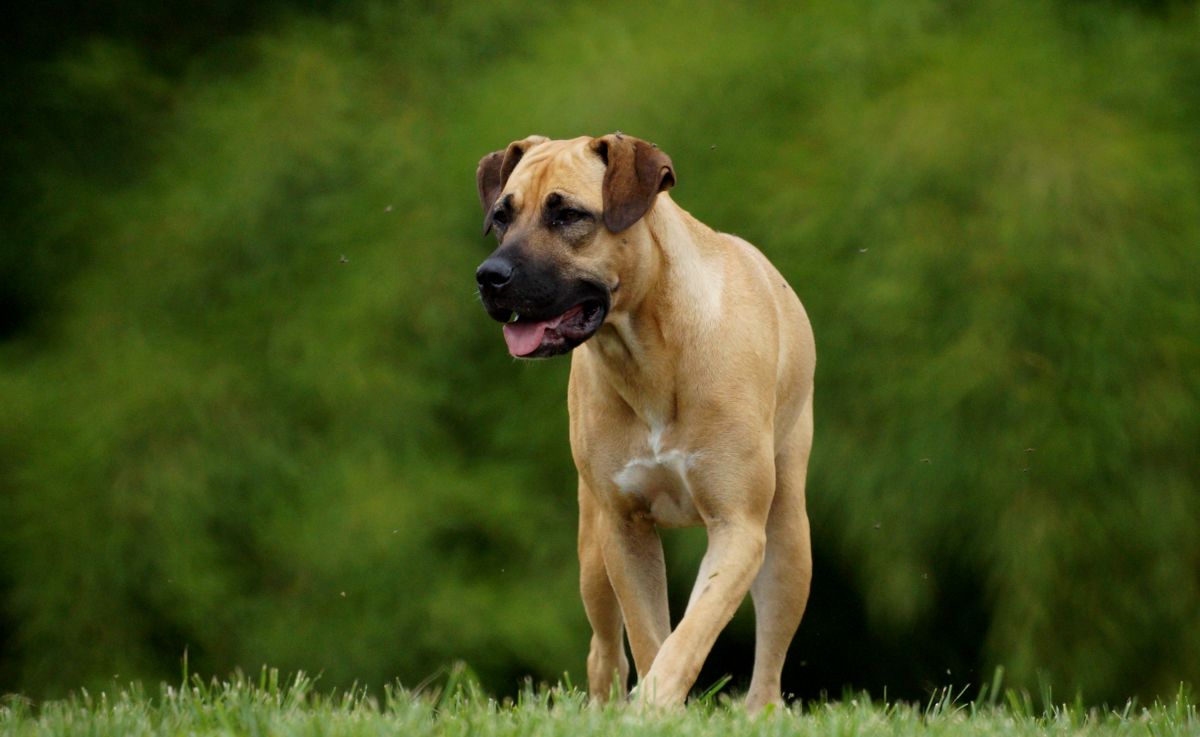
Picking the wrong size category is the single biggest source of error in a puppy weight prediction — more than any imprecision in the formula itself. The category should reflect the breed(s) your puppy is expected to grow into as an adult, not how big it looks right now, since an 8-week-old giant-breed puppy and an 8-week-old toy-breed puppy can weigh nearly the same amount.
A few reference points that help narrow it down:
- Toy / Small (under 20 lb adult): Chihuahua, Yorkshire Terrier, Pomeranian, Dachshund
- Medium (20–50 lb adult): Border Collie, Cocker Spaniel, Bulldog, Beagle
- Large (50–90 lb adult): Labrador Retriever, Golden Retriever, German Shepherd
- Giant (over 90 lb adult): Great Dane, Mastiff, Saint Bernard, Newfoundland

⚠️ Note
Paw size relative to leg and body is a classic (if informal) sign vets and breeders use to spot a puppy that's going to outgrow its current size category — proportionally oversized paws at 8–12 weeks often signal more growth still ahead.
What About Mixed Breeds and Rescues?
For a mixed-breed puppy of unknown parentage, the size category becomes an educated estimate rather than a known fact — which is exactly why the calculator's ±15% range matters more for a rescue than for a purebred puppy from a known litter. Shelters commonly guess breed mix by appearance alone, and appearance-based breed guesses are frequently wrong even for experienced staff — DNA testing studies have repeatedly found mismatches between visual guesses and lab results in a majority of shelter dogs tested.
Three things narrow the estimate: average the parents' known adult weights if you have them, re-weigh at two or more points between 8 and 16 weeks instead of trusting a single early guess, and ask your vet to assess frame and paw size at a checkup. A DNA test is the most reliable option if the answer genuinely matters for planning — housing, food budget, or breed-specific health screening.
How to Track Growth Instead of Guessing Once
A single weigh-in captures one point on a growth curve — tracking weight every 2–4 weeks through the first 6 months captures the trend, and the trend is what confirms or corrects an early prediction. Otis's own numbers show why: the 8-week estimate (37.5 lb) and the 16-week estimate (48 lb) disagreed by over 10 lb, and the 16-week number was the more accurate one simply because it was taken later.

A practical routine that works for most owners:
| When | What to do |
|---|---|
| 8 weeks | First weigh-in and rough size category guess |
| 12 weeks | Re-weigh, refine category if paw size/frame gives new clues |
| 16 weeks | Re-weigh — most reliable early prediction window |
| Every 4 weeks after | Track the trend against the growth curve until maturity |
Key Takeaway
A prediction taken between 8 and 24 weeks of age is generally accurate within about 10–20% for a purebred puppy — accuracy improves with each later re-weigh, and drops for mixed breeds of unknown parentage or for very young puppies.
Frequently Asked Questions
Is "double your puppy's weight at 8 weeks" ever accurate?
It's a reasonable guess for toy and small breeds, which do reach close to 50% of adult weight around 8–12 weeks. For medium, large, and giant breeds, that milestone lands much later, so doubling an 8-week weight underestimates adult size — sometimes by more than half.
At what age is a puppy weight prediction most accurate?
Predictions taken between 16 and 24 weeks tend to be more reliable than very early estimates, because less of the growth curve remains ahead to compound any error. Re-weighing at multiple points and comparing the trend beats any single measurement.
How do I know what size category my mixed-breed puppy will grow into?
Use whatever is known about the parent breeds' adult sizes as a starting estimate, ask your vet to assess frame and paw size, and treat DNA testing as the most reliable option if it genuinely matters for planning. Shelter guesses based on appearance alone are frequently inaccurate compared to DNA results.
Does spaying or neutering change how big a puppy will get?
Research is mixed, but some studies suggest early spay/neuter (before growth plates close) can modestly extend the growth period in certain breeds, sometimes producing a slightly taller adult frame. It's a secondary factor next to breed and genetics, best discussed with a vet.
My puppy's growth doesn't match the predicted range at all — should I be concerned?
A puppy tracking well outside the predicted ±15% range, especially alongside reduced appetite, lethargy, or an unusually round or firm abdomen, is worth flagging to a vet. Growth-curve predictions are statistical averages, not medical assessments.
Try It Yourself
A single early weigh-in and a doubling rule can leave you off by dozens of pounds — the actual math depends on which size category your puppy is growing into, and how far along its own growth curve it already is.
Use the Puppy Weight Calculator to run your own puppy's numbers — enter current weight, age in weeks, and expected adult size to get a predicted adult weight plus a likely range.
Also worth checking:
- Dog Food Portion Calculator — once you have a target adult weight, calculate daily calories and feeding portions
- Cat Calorie Calculator — the same resting-energy approach, sized for cats
- Dog Age Calculator — see your puppy's age in human years as it grows


