My Bike Tire Gauge Said I Had a Slow Leak. It Was Just the Ideal Gas Law.
I pumped my road bike tires to 100 psi before an early ride, checked them again after leaving the bike in the sun on the porch for a few hours, and the gauge read 114 psi. My first thought was that the gauge was broken, because a sealed tire doesn't gain air on its own. It wasn't broken. The tire hadn't gained a single molecule of air — the air already inside it had just gotten hotter, and hotter gas pushes harder on the walls containing it. The equation that predicts exactly how much harder, down to the psi, is one most people last saw in a high school chemistry class and never connected to anything real: the ideal gas law.
Key Takeaway
The ideal gas law, PV = nRT, links a gas's pressure, volume, amount, and temperature into one equation. Hold two of those quantities steady and change a third, and the fourth is forced to move — which is why a sealed tire, can, or bag responds to temperature and altitude even though nothing was added or removed.
This article walks through what each letter in PV = nRT actually means, then uses that hot bike tire, an aerosol can left in a car, and a bag of chips that puffs up on a mountain drive to show the equation working in situations you've probably already lived through.
What Is the Ideal Gas Law and Why Does It Matter?
The ideal gas law is the equation PV = nRT, which relates a gas's pressure (P), volume (V), amount in moles (n), and absolute temperature (T) through the universal gas constant R. It was first written in this combined form by French engineer Émile Clapeyron in 1834, merging three separate relationships — Boyle's, Charles's, and Gay-Lussac's laws — that chemists and physicists had worked out independently over the preceding 170 years.
The reason it matters outside a classroom is the same reason Ohm's Law matters in a circuit: it's not just something to solve for homework, it's a constraint. In a sealed container, if the amount of gas doesn't change, then pressure, volume, and temperature are locked together — push one, and at least one of the others has to move, whether that's convenient or not. That's exactly what turned a routine tire check into a moment of unnecessary alarm.
According to the National Institute of Standards and Technology (NIST), the universal gas constant R has a fixed value of 8.31446 J/(mol·K) — expressed as 0.0821 L·atm/(mol·K) in the units most chemistry problems use, and the value this article uses throughout.
The Hot Tire: PV = nRT in a Bike Tire
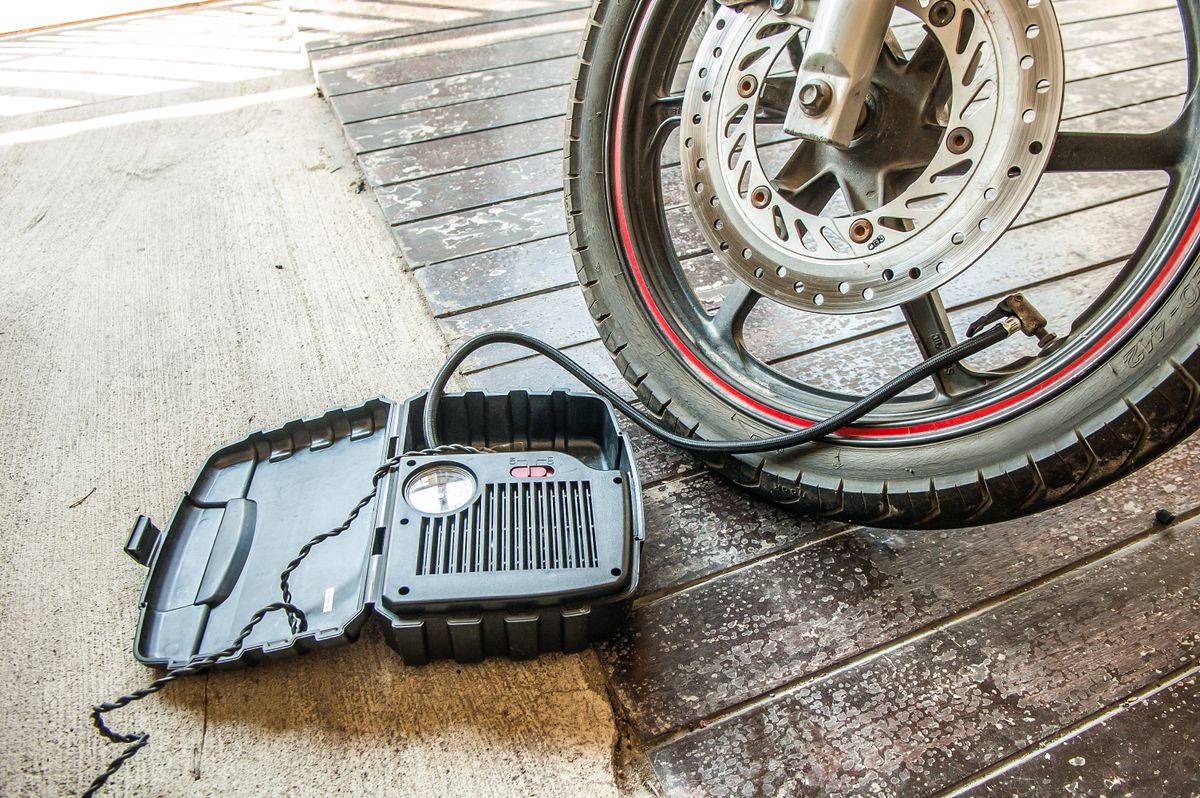
A road bike tire holds a fixed amount of air — nothing leaks in or out over the course of an afternoon — and its volume barely changes once it's inflated, since the tire's casing is stiff at 100 psi. That leaves temperature as the only thing free to move, which means pressure has to move with it.
Here's the full calculation, not just the shortcut. My tire held about 2.3 liters of air (a typical 700×25c road tire volume), pumped to 100 psi on the gauge. A gauge reads relative to atmospheric pressure, so the absolute pressure the gas law needs is 100 + 14.7 = 114.7 psi, or 7.81 atm. At a cool morning temperature of 15°C (288 K), the amount of air in the tire works out to:
That's about 0.76 moles of air sealed inside — roughly 17 liters of air at normal atmospheric pressure, compressed down into a 2.3-liter tire. Now hold that amount of gas (n) and that volume (V) constant, and raise the temperature to 50°C (323 K), which is a realistic surface temperature for a dark tire sitting in direct sun. Solving PV = nRT for the new pressure:
Subtract the 14.7 psi of atmosphere back out and that's about 114 psi on the gauge — almost exactly what mine read. A 35°C temperature swing, with nothing added or removed, produced a 14 psi jump.
⚠️ Note
Most road tires are rated for a maximum pressure somewhere around 120–130 psi. Pumping a tire to its limit on a cool morning and then leaving it in direct sun or a hot car trunk can push it over that rating purely from heat, with no puncture or overfilling involved. It's worth checking a tire's max-pressure rating and leaving a small margin below it in hot weather.
The Ideal Gas Law Calculator does this exact PV = nRT math for any three known values — plug in pressure, volume, and temperature in whatever units are on your gauge, and it solves for moles, or rearranges to solve for whichever value you're missing.
Why Aerosol Cans Warn You Not to Leave Them in a Hot Car
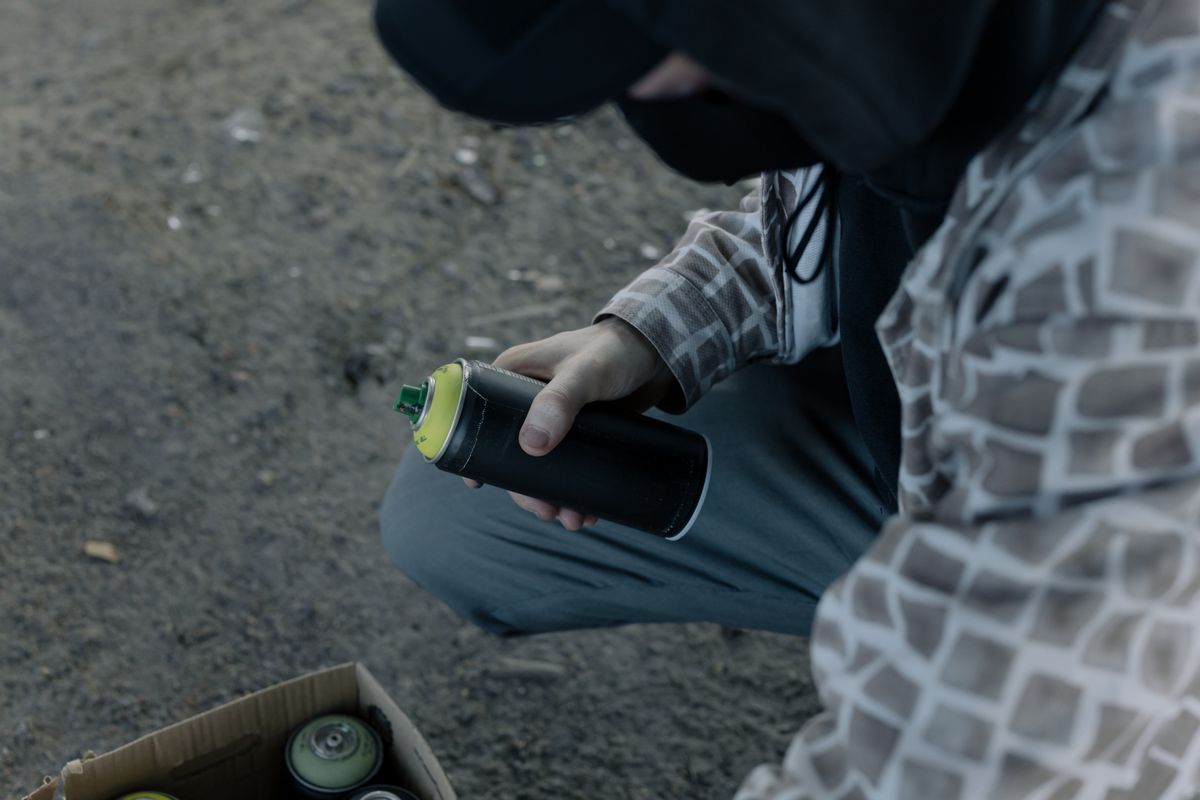
Every aerosol can — spray paint, deodorant, sunscreen — carries a warning label limiting storage temperature, typically around 120°F (49°C). That number isn't arbitrary; it's the ideal gas law again, applied to a sealed metal container instead of a bike tire.
A typical aerosol can holds propellant gas at roughly 3 atm of internal pressure at room temperature (20°C, or 293 K). Leave that can on a dashboard in summer, where cabin temperatures regularly reach 60°C (333 K) even on a mild day, and — with volume and the amount of gas both fixed by the sealed can — the pressure rises in direct proportion to the absolute temperature:
That's roughly a 14% pressure increase from a 40°C swing — and it climbs further if the can gets hotter still, which is exactly why aerosol cans are pressure-tested and rated to fail (rupture or vent) well beyond normal use, but not indefinitely. The U.S. Consumer Product Safety Commission has documented aerosol can ruptures and fires linked to cans left in hot vehicles or near heat sources, which is the practical reason those storage-temperature warnings exist in the first place.
💡 Pro Tip
The same math applies to any sealed rigid container heating up: a propane cylinder in direct sun, a sealed water bottle left in a hot car, or a CO₂ cartridge. If you know a starting pressure and temperature, the Ideal Gas Law Calculator will show you the resulting pressure at any new temperature, so "how hot is too hot" stops being a guess.
Why a Sealed Bag of Chips Puffs Up on a Mountain Drive
The tire and the aerosol can both held volume roughly fixed and let pressure and temperature move together. A bag of chips does the opposite: it's a flexible container, so when the outside pressure drops, the bag itself expands instead of the internal pressure spiking.
Boyle's Law is the special case of the ideal gas law where temperature and the amount of gas stay constant, leaving pressure and volume inversely proportional (P₁V₁ = P₂V₂). A bag of chips is sealed at sea level, at roughly 1 atm, with nitrogen gas added deliberately to cushion the chips during shipping. Drive that bag up to a mountain town at 2,400 meters (about 7,900 feet) elevation, where atmospheric pressure drops to roughly 0.75 atm, and the trapped gas inside the bag is now at a much higher pressure than the air outside it. Since the bag material can stretch, the gas expands until the pressures come closer to equilibrium:

That's roughly a 33% volume increase from elevation alone — enough to visibly balloon a sealed bag, and the same underlying effect behind ears popping, a sealed water bottle crackling when opened after a flight, and why airlines pressurize cabins to roughly the equivalent of 8,000 feet instead of leaving them at outside atmospheric pressure at cruising altitude.
⚠️ Note
Boyle's Law only isolates pressure and volume because temperature and the amount of gas are assumed constant. In practice, a car cabin driving up a mountain also cools somewhat with elevation, which works in the same direction (colder gas takes up less space) but is usually a smaller effect than the pressure drop itself for a short drive.
Pressure, Volume, Moles, and Temperature — What Each One Means
Each letter in PV = nRT stands for something you can point to physically:
| Symbol | Quantity | Common units | What it means |
|---|---|---|---|
| P | Pressure | atm, psi, kPa | Force the gas exerts per unit area on its container |
| V | Volume | liters, ft³ | Space the gas occupies |
| n | Moles | mol | Amount of gas, as a molecule count (6.022 × 10²³ per mole) |
| T | Temperature | kelvin (K) | Average kinetic energy of the gas molecules |
Temperature in the ideal gas law must be an absolute scale — kelvin, not Celsius or Fahrenheit — because the relationship is a direct proportion that only holds when zero actually means zero energy. Plugging Celsius into PV = nRT directly (say, using 0°C instead of 273.15 K) would make pressure appear to hit zero at freezing point, which isn't physically true and produces wrong answers throughout the calculation.
Key Takeaway
At standard temperature and pressure (0°C and 1 atm, commonly abbreviated STP), one mole of any ideal gas occupies 22.4 liters — a fixed reference volume used throughout chemistry to convert between a gas's mass, mole count, and volume without weighing it directly.
How Do the Individual Gas Laws Compare?
PV = nRT is really four simpler relationships stacked together, each one holding two of the four quantities fixed while the other two move:
| Law | Formula | Held constant | Where it showed up above |
|---|---|---|---|
| Boyle's Law | P₁V₁ = P₂V₂ | Temperature, moles | The bag of chips puffing at altitude |
| Gay-Lussac's Law | P₁/T₁ = P₂/T₂ | Volume, moles | The hot tire and the aerosol can |
| Charles's Law | V₁/T₁ = V₂/T₂ | Pressure, moles | A hot-air balloon expanding as it's heated |
| Avogadro's Law | V₁/n₁ = V₂/n₂ | Pressure, temperature | Inflating a balloon by adding more air |
The tire and the aerosol can example both used Gay-Lussac's Law in practice, since a rigid sealed container keeps volume fixed. The chip bag example used Boyle's Law, since a flexible container keeps temperature and gas amount roughly fixed instead. Both are just PV = nRT with two of the four letters held still.
Frequently Asked Questions
Does the ideal gas law apply to real gases like air, or only theoretical ones?
It applies closely enough to real gases like air at normal pressures and temperatures — the tire, aerosol can, and chip bag examples above are all within a few percent of what a real gas actually does. It becomes noticeably less accurate at very high pressure or very low temperature, where intermolecular forces and the actual volume of gas molecules — both ignored by the ideal model — start to matter. Real gases under those extreme conditions are better modeled with the Van der Waals equation.
Why did my tire pressure go up in the sun if I didn't add any air?
The amount of air (moles) inside a sealed tire doesn't change from sitting in the sun, and the tire's volume barely changes either, since it's already at high pressure and fairly rigid. That leaves pressure and temperature to move together — as the trapped air heats up, its molecules move faster and strike the tire's inner walls harder and more often, which is measured as higher pressure, exactly as Gay-Lussac's Law (P₁/T₁ = P₂/T₂) predicts.
Is it dangerous to leave an aerosol can in a hot car?
It can be. Aerosol cans are pressure-rated with a safety margin, but heat raises internal pressure in direct proportion to absolute temperature (in kelvin), and a hot car interior can reach temperatures well above the can's stated safe-storage limit — commonly around 120°F (49°C). Manufacturers and the U.S. Consumer Product Safety Commission both warn against storing aerosol cans in vehicles or near other heat sources for exactly this reason.
What's the difference between the ideal gas law and Boyle's Law?
Boyle's Law (P₁V₁ = P₂V₂) is a special case of the ideal gas law that only holds when temperature and the amount of gas stay constant, leaving pressure and volume inversely proportional. The ideal gas law (PV = nRT) is the general equation that lets all four quantities — pressure, volume, moles, and temperature — change at once, and Boyle's, Charles's, Gay-Lussac's, and Avogadro's laws are all specific slices of it.
Why do you have to use kelvin instead of Celsius in PV = nRT?
The ideal gas law is a direct proportion between temperature and pressure (or volume), and a direct proportion only makes physical sense on a scale where zero actually represents zero — the point of no molecular motion, which is 0 K (−273.15°C). Celsius and Fahrenheit both have arbitrary zero points, so plugging them directly into PV = nRT gives wrong answers; convert to kelvin first by adding 273.15 to a Celsius value.
Try It Yourself
A bike tire gaining 14 psi in the sun, a spray can's storage warning, and a bag of chips puffing up on a mountain pass are three completely different objects obeying the exact same equation. Once PV = nRT clicks, none of them look like a mystery anymore.
Use the Ideal Gas Law Calculator to solve for pressure, volume, moles, or temperature from any three known values, in whichever units you have on hand.
Also worth checking:
- BTU / HVAC Calculator — size heating and cooling loads, another place where temperature and pressure differences drive real-world numbers
- Pressure Converter — convert between atm, psi, kPa, bar, and mmHg before plugging values into the gas law
- Temperature Converter — convert Celsius or Fahrenheit readings to kelvin
- Volume Converter — convert between liters, cubic feet, and other volume units