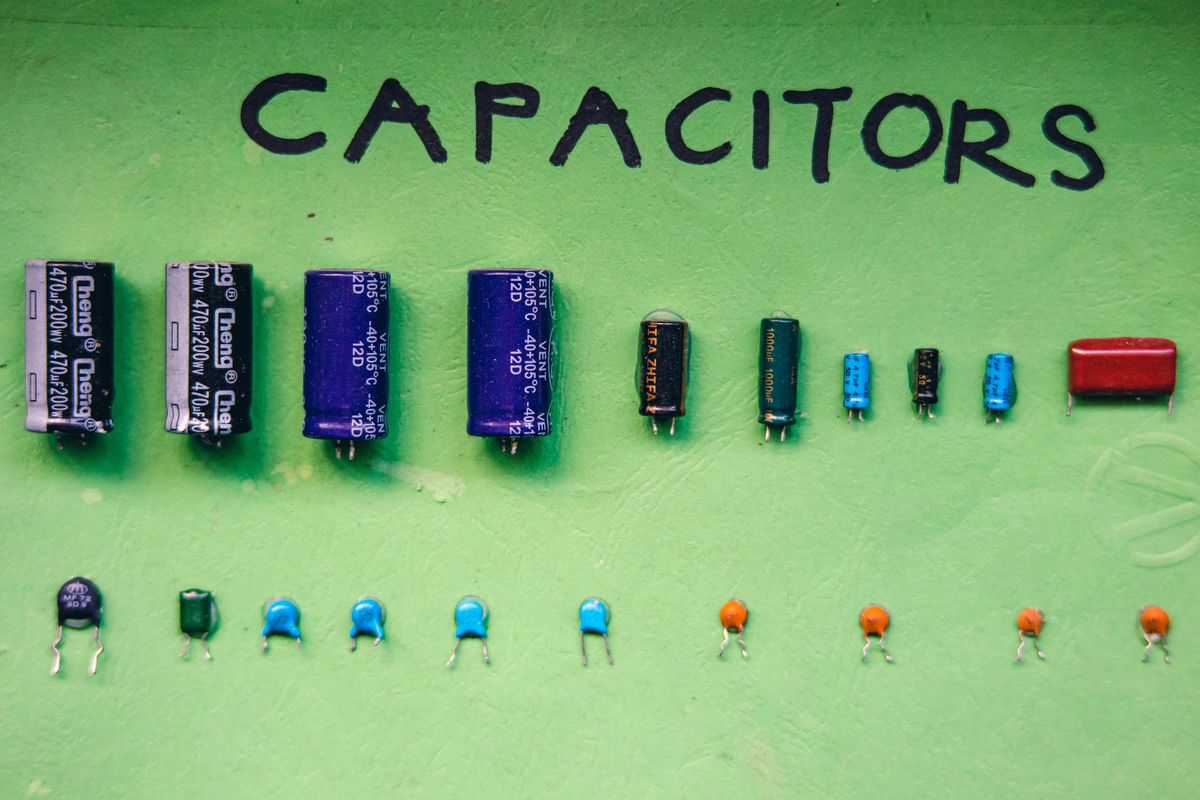
What Is a Capacitor Code Calculator and How Does It Work?
A capacitor code calculator translates the short numeric marking printed on a ceramic or film capacitor — such as 104 or 473J — into a usable capacitance value in picofarads (pF), nanofarads (nF), or microfarads (µF). It reverses the EIA-198 shorthand manufacturers use because a capacitor's body is too small to print a full value like "0.1 µF".
The EIA-198 3-digit code formula is: capacitance (pF) = first two digits × 10^(third digit). For example, the code "104" means 10 × 10⁴ = 100,000 pF, which equals 100 nF or 0.1 µF. Values under 10 pF skip the multiplier entirely and use "R-notation" instead, where the letter R replaces the decimal point — "4R7" means 4.7 pF.
According to the EIA-198 standard used industry-wide since the 1960s, a trailing letter after the digits specifies the manufacturing tolerance — for example, "104K" is a 100,000 pF (0.1 µF) capacitor with a tolerance of ±10%, meaning the true value could fall anywhere between 90,000 and 110,000 pF.
How to Use This Capacitor Code Calculator
Switch between two modes depending on what you know: enter the printed code to see its capacitance, or enter a capacitance value to find the code you should look for.
- Decode Code → Value: Type the marking exactly as printed on the capacitor, including any trailing tolerance letter — e.g. "104K", "473J", or "4R7".
- Convert Value → Code: Enter a capacitance and pick pF, nF, or µF; the calculator finds the standard EIA-198 code and lets you append a tolerance letter.
- Tolerance letter: Common values are J (±5%), K (±10%), and M (±20%) for general-purpose ceramic capacitors; B, C, and D denote tight absolute tolerances in picofarads for small-value NP0/C0G capacitors used in filters and oscillators.
This coding system is used internationally on ceramic disc, monolithic, and film capacitors regardless of country, so the same 3-digit or 4-digit markings apply whether the part was sourced in the US, Europe, or Asia — there is no metric/imperial distinction to worry about.
Capacitor Multiplier Digits and Tolerance Letters
The table below shows how each multiplier digit and tolerance letter maps to a real-world value — the same reference data this calculator uses internally.
| Multiplier Digit | Multiplier | Example Code → Value |
|---|---|---|
| 0 | ×1 | 220 → 22 pF |
| 1 | ×10 | 221 → 220 pF |
| 2 | ×100 | 222 → 2,200 pF (2.2 nF) |
| 3 | ×1,000 | 333 → 33,000 pF (33 nF) |
| 4 | ×10,000 | 104 → 100,000 pF (0.1 µF) |
| 5 | ×100,000 | 105 → 1,000,000 pF (1 µF) |
| 8 / 9 | ×0.01 / ×0.1 | 339 → 33 × 0.1 = 3.3 pF |
Frequently Asked Questions
What does the code 104 mean on a capacitor?
A capacitor marked "104" is 100,000 picofarads, which equals 100 nanofarads or 0.1 microfarads. The "10" is the significant digits and the final "4" tells you to multiply by 10⁴ (10,000) in picofarads — this is one of the most common bypass/decoupling capacitor values in electronics.
How accurate is this capacitor code calculator?
This calculator applies the EIA-198 standard used by essentially all ceramic and film capacitor manufacturers, so decoded values are exact for correctly formatted codes. The one limitation is genuine ambiguity in the source: some very small capacitors print their pF value directly instead of coding it, so always sanity-check an implausible result against the part's datasheet.
What is the difference between a 3-digit code and R-notation?
A 3-digit code (like 104) always applies a multiplier to two significant digits and is used for capacitors 10 pF and above. R-notation (like 4R7) is used instead for capacitors under 10 pF, where the letter R stands in for a decimal point so the marking can be read directly as a pF value — 4R7 is 4.7 pF, not 47 pF.
What tolerance letter should I use if my capacitor has none printed?
A capacitor with no tolerance letter has an unspecified or manufacturer-default tolerance, commonly ±20% (equivalent to a "M" code) for general-purpose ceramic capacitors. For circuits where precision matters, such as timing or filter circuits, look for parts explicitly marked with a J (±5%) or tighter tolerance letter.