My Phone Charger Cable Was Getting Hot — Ohm's Law Explained the Way I Should Have Learned It
A cheap replacement USB cable I'd bought for a few dollars was getting noticeably warm every time I fast-charged my phone on it — warm enough that I stopped leaving it plugged in overnight. My first assumption was that the cable was faulty or unsafe. It wasn't. It was thinner than the cable it replaced, which meant more electrical resistance packed into the same length, and at 3A of fast-charging current, that extra resistance was turning into real heat. The number that explained all of it was one I'd half-memorized in school and never actually understood: Ohm's Law.
Key Takeaway
Ohm's Law states that voltage equals current multiplied by resistance (V = I × R). It describes a fixed relationship between three quantities — change any one of them, and at least one of the others has to change too, whether you intend it or not.
This article walks through what voltage, current, and resistance actually mean, why V = I × R holds in a normal circuit, and how to rearrange it to solve for whichever value you don't already know — using that hot charging cable as the running example, so the numbers stay grounded in something real rather than an abstract circuit diagram.
What Is Ohm's Law and Why Does It Matter?
Ohm's Law is the equation V = I × R, where V is voltage in volts, I is current in amps, and R is resistance in ohms. It was published in 1827 by German physicist Georg Ohm, based on experiments measuring how current through a wire changed with applied voltage, and it remains the single most-used equation in basic electronics because almost every other circuit calculation builds on it.
The reason it matters outside a physics classroom is that it's not just a formula to solve for homework — it's a constraint. In any simple resistive circuit, if you know two of the three values, the third is already determined. You don't get to pick a voltage, a current, and a resistance independently and have them all be whatever you want; the physics forces one of them to be whatever V = I × R says it has to be.

That's exactly what was happening in my charging cable, and it's the same relationship behind why a dimmer switch gets warm, why long extension cords aren't rated for as much current as short ones, and why a resistor's rating matters as much as its resistance value.
The Hot Cable: Ohm's Law in a USB Wire
A USB cable isn't just a passive connector — the copper wire inside it has a small but real resistance, typically somewhere around 0.1–0.3Ω per meter for the thin conductors used in phone cables, higher in cheaper or thinner cables. My phone was pulling 3A during fast charging (a common rate for USB Power Delivery and Quick Charge devices), and the cheap replacement cable measured roughly 0.4Ω end-to-end — nearly double the 0.22Ω of the original cable it replaced.
Using V = I × R, the voltage dropped across the cable itself (not the voltage delivered to the phone) was:
That 1.2V wasn't reaching my phone — it was being dissipated as heat inside the cable. The original 0.22Ω cable, at the same 3A, only dropped 0.66V. Roughly double the resistance meant roughly double the wasted voltage, and since power dissipated as heat is P = V × I, that's 3.6W in the cheap cable versus 1.98W in the original — nearly double the heat, concentrated in a few grams of copper and plastic insulation.
⚠️ Note
A cable or wire getting warm under load isn't automatically dangerous — some voltage drop and heat is normal, especially with thin, long, or high-current cables. It becomes a problem when the cable is hot to the touch, the insulation feels soft, or the charging rate visibly slows down, all of which suggest resistance well above what the wire gauge was designed for.
The Ohm's Law Calculator does this exact V = I × R math for any two known values, and the Wire Gauge Calculator goes a step further, estimating a wire's resistance and safe current-carrying capacity from its gauge and length — useful before assuming a cable, extension cord, or wire run is fine at a given current.
Voltage, Current, and Resistance — What Each One Actually Is
Ohm's Law only makes intuitive sense once the three quantities stop being abstract letters and start meaning something physical. A common (imperfect but useful) analogy is water flowing through a pipe:
| Quantity | Symbol | Unit | Water analogy |
|---|---|---|---|
| Voltage | V | Volt (V) | Water pressure pushing the flow |
| Current | I | Amp (A) | Rate of water actually flowing |
| Resistance | R | Ohm (Ω) | Narrowness of the pipe restricting flow |
Voltage is the electrical "pressure" pushing charge through a circuit, measured in volts. A higher voltage pushes harder, but on its own it doesn't tell you how much current will actually flow — that depends on how much resistance is in the way.
Current is the actual rate of charge flow through a circuit, measured in amps. One amp is defined as one coulomb of charge passing a point per second. Current is what does the work (and generates the heat) — a circuit with high voltage but negligible current draw, like a static shock, can be harmless, while a circuit with only a few volts but very high current can be dangerous.
Resistance is a material's or component's opposition to current flow, measured in ohms. A thicker, shorter, more conductive wire has lower resistance; a thinner, longer, or less conductive one has higher resistance — which is precisely why the cheap USB cable in the earlier example ran hotter than the original.
How Do You Calculate Voltage, Current, or Resistance?
Ohm's Law can be rearranged into three forms, one for each variable you might need to solve for, as long as you know the other two:
- Solving for voltage: multiply current by resistance. A 2A current through a 10Ω resistor produces V = 2 × 10 = 20V across it.
- Solving for current: divide voltage by resistance. A 12V car battery connected to a 4Ω heating element draws I = 12 ÷ 4 = 3A.
- Solving for resistance: divide voltage by current. If a component drops 9V while carrying 0.5A, its resistance is R = 9 ÷ 0.5 = 18Ω.
💡 Pro Tip
Rather than re-deriving which side of the equation to divide or multiply, it's faster to just plug in the two values you know. The Ohm's Law Calculator lets you pick which variable you're solving for and enter the other two — it handles the rearrangement and returns voltage, current, resistance, and power together.
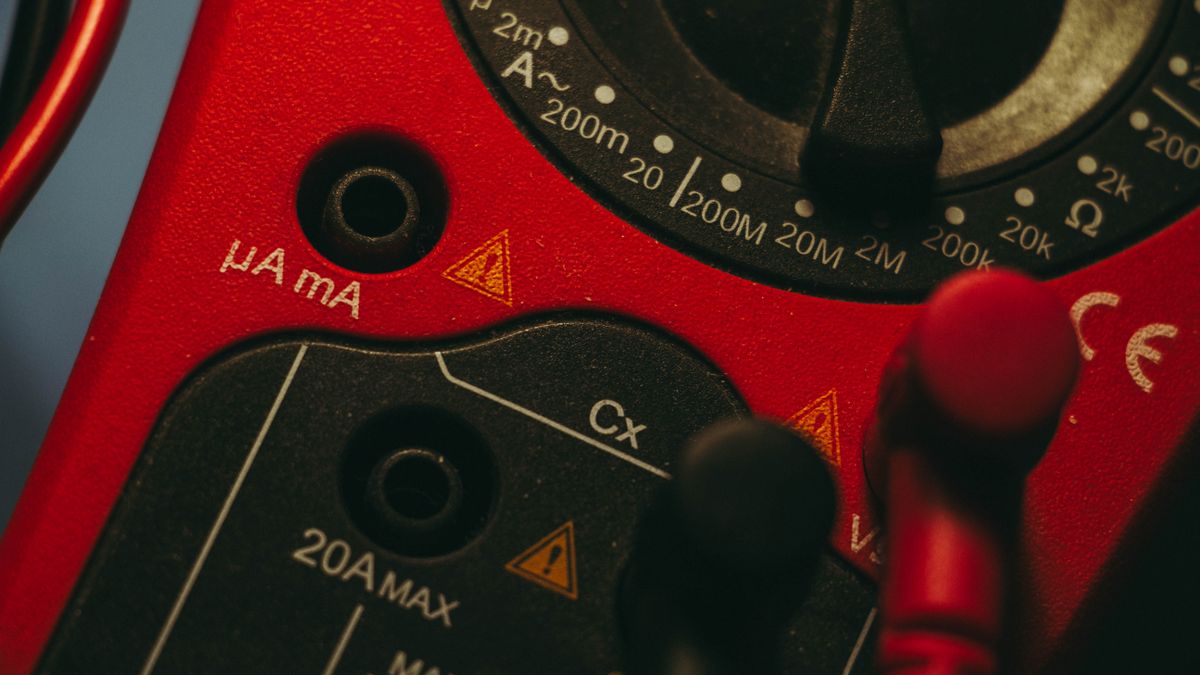
A multimeter is how most of these values get measured in practice — set to the voltage (V), current (A), or resistance (Ω) setting depending on which quantity you're checking, since a single meter typically can't measure all three on a live circuit at once without changing its configuration.
Where Does Power (Watts) Fit In?
Power is the rate of energy consumption or dissipation in a circuit, measured in watts, and is calculated as P = V × I — voltage multiplied by current. It's not technically part of Ohm's Law itself, but it's used alongside it so often that most calculators, including the Ohm's Law Calculator, return it automatically once V and I are known.
Substituting Ohm's Law into the power formula gives two more useful variants:
This is why a light bulb's wattage rating matters as much as its voltage rating: a 60W bulb at 120V draws about 0.5A (I = P ÷ V), while the same 60W at 230V draws roughly half that current — one reason 230V mains regions can generally use thinner wiring for the same delivered power than 120V regions.

In the charging cable example, the "wasted" 3.6W wasn't purely academic — it's roughly equivalent to the heat output of a small night light, generated inside a cable a few millimeters thick, which is exactly why it felt warm to the touch.
Common Ohm's Law Mistakes
A handful of mix-ups come up repeatedly, even among people who technically know the formula:
- Using the supply voltage instead of the voltage across the specific component. In a circuit with multiple parts, V = I × R applies to each part's own voltage drop and resistance, not necessarily the full battery or source voltage — this is the same trap that caused confusion in the cable example above.
- Forgetting that resistance isn't always constant. Ohm's Law assumes a linear ("ohmic") relationship, which holds for simple components like resistors and wires at a stable temperature, but doesn't hold for things like LEDs, diodes, or heavily heated filaments, where resistance shifts with current or temperature.
- Mixing up units. Ohm's Law requires volts, amps, and ohms specifically — plugging in milliamps or kilohms without converting first is one of the most common sources of a wildly wrong answer.
- Assuming higher voltage is always more dangerous than higher current. Current is what actually causes tissue and equipment damage; voltage only matters insofar as it's high enough, relative to resistance, to push a dangerous current through.
⚠️ Note
Ohm's Law describes resistive circuits well, but real components like LEDs need a separate approach since their resistance isn't fixed — that's what a dedicated tool like the LED Resistor Calculator accounts for.

Frequently Asked Questions
What is the simplest way to remember Ohm's Law?
V = I × R is the core equation — voltage equals current times resistance. If you know any two of the three values, you can always rearrange it: I = V ÷ R to find current, or R = V ÷ I to find resistance. Many people use a triangle mnemonic (V on top, I and R on the bottom) as a visual shortcut for the rearrangement.
Does Ohm's Law apply to every electrical component?
No. It applies reliably to "ohmic" components — plain resistors and most wires — where resistance stays roughly constant regardless of the current flowing through them. Components like diodes, LEDs, and transistors are "non-ohmic": their effective resistance changes with current and temperature, so V = I × R alone doesn't fully describe their behavior.
Why did my charging cable get warm but not my phone charger's brick?
The wall adapter (brick) is designed with low internal resistance and adequate heatsinking for its rated current, while a thin, cheap cable can have proportionally much higher resistance for its size. Since heat dissipated is P = I² × R, even a small increase in a cable's resistance produces a noticeable increase in heat at high charging currents like 3A.
Is higher voltage or higher current more dangerous?
Current is generally considered the more directly dangerous factor to the human body, since it's current that disrupts muscle and nerve function. However, voltage is what pushes current through resistance (including the body's own resistance), so the two aren't fully separable — a higher voltage across a given resistance will always produce a higher current, per Ohm's Law itself.
How is Ohm's Law different from the power formula?
Ohm's Law (V = I × R) relates voltage, current, and resistance. The power formula (P = V × I) relates voltage, current, and power (energy per second, in watts) instead. They're often used together — once you know any two of voltage, current, or resistance from Ohm's Law, you can plug the resulting voltage and current into P = V × I to find power.
Try It Yourself
A cheap cable running warm turned out to be nothing more exotic than Ohm's Law doing exactly what it always does — a little extra resistance, at a real current, showing up as real heat. The same relationship applies whether you're sizing a wire, checking a resistor, or just trying to understand why one cable runs hotter than another.
Use the Ohm's Law Calculator to solve for voltage, current, resistance, or power from any two known values.
Also worth checking:
- Wire Gauge Calculator — estimate a wire's resistance and safe current capacity from its gauge and length
- Voltage Divider Calculator — see how two resistors split a voltage in a circuit
- Resistor Color Code Calculator — decode a resistor's value from its color bands
- LED Resistor Calculator — find the right resistor value for an LED at a given supply voltage
- Resistor Calculator — work out combined resistance for resistors in series or parallel